Post RFQ Project Surplus
Register
#

Note: All images shown are for illustration purposes only. Actual item may vary. For any other similar item, submit RFQ or send an email at contact@surplus.com.pk or call us at: 0333-4476542.

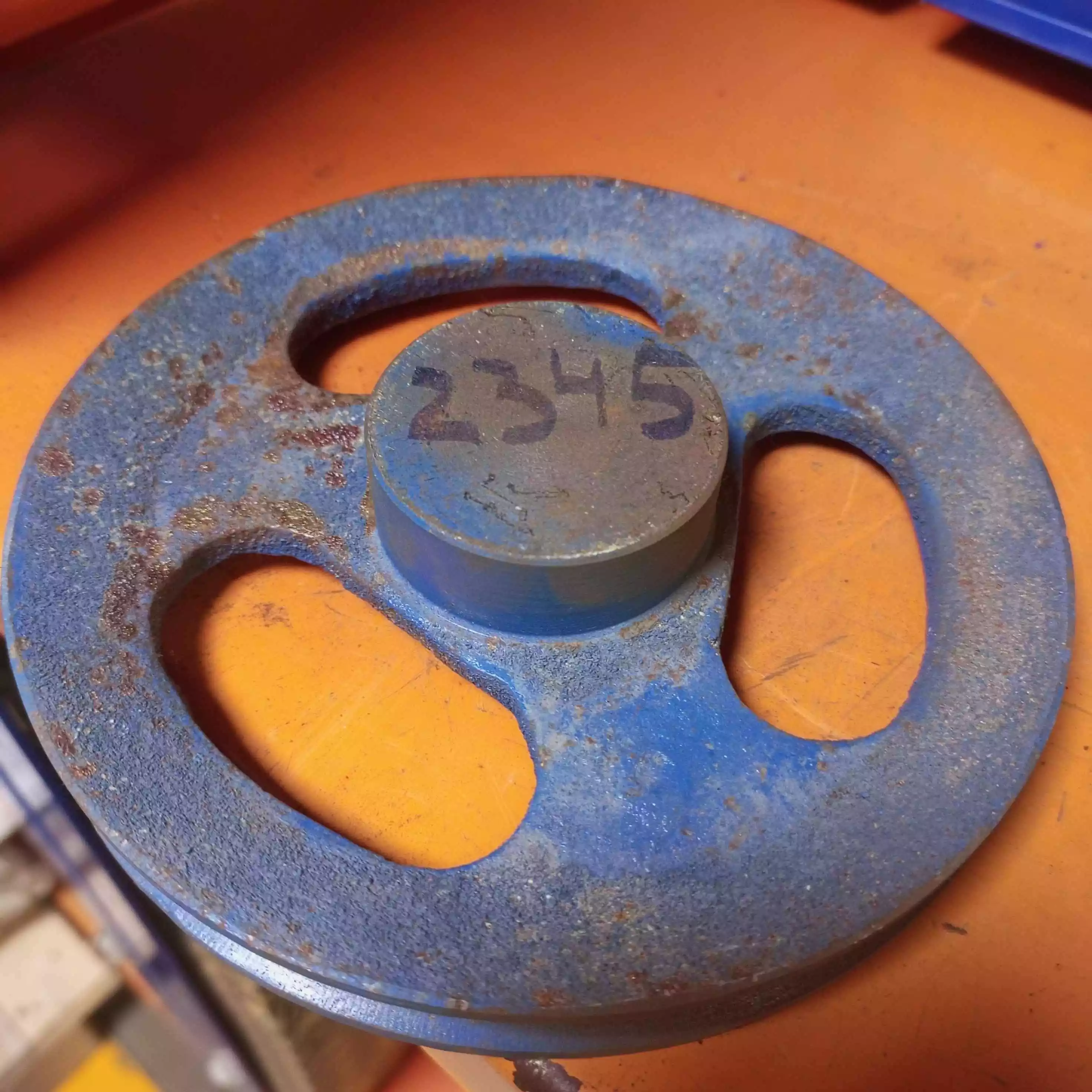
CI PULLY A TYPE 1 GROOVE 6" WITHOUT BORE

Category:Mechanical, Engineering Components

Sub Category:Industrial products, spares & supplies

Available Quantity: 2 each

Item's Model No: 0

Condition: New


Note: All images shown are for illustration purposes only. Actual item may vary. For any other similar item, submit RFQ or send an email at contact@surplus.com.pk or call us at: 0333-4476542.

  • Item ID 28456
  • Condition New
  • Manufacturer Null
  • Manufacturing Date 0000-00-00
  • Item's Model No 0

CI PULLY A TYPE 1 GROOVE 6" WITHOUT BORE

CI PULLY A TYPE 1 GROOVE 6" WITHOUT BORE A belt is a loop of flexible material used to link two or more rotating shafts mechanically, most often parallel. Belts may be used as a source of motion, to transmit power efficiently, or to track relative movement. Belts are looped over pulleys and may have a twist between the pulleys, and the shafts need not be parallel. In a two pulley system, the belt can either drive the pulleys normally in one direction (the same if on parallel shafts), or the belt may be crossed, so that the direction of the driven shaft is reversed (the opposite direction to the driver if on parallel shafts). As a source of motion, a conveyor belt is one application where the belt is adapted to carry a load continuously between two points. V belts (also style V-belts, vee belts, or, less commonly, wedge rope) solved the slippage and alignment problem. It is now the basic belt for power transmission. They provide the best combination of traction, speed of movement, load of the bearings, and long service life. They are generally endless, and their general cross-section shape is trapezoidal (hence the name "V"). The "V" shape of the belt tracks in a mating groove in the pulley (or sheave), with the result that the belt cannot slip off. The belt also tends to wedge into the groove as the load increases—the greater the load, the greater the wedging action—improving torque transmission and making the V-belt an effective solution, needing less width and tension than flat belts. V-belts trump flat belts with their small center distances and high reduction ratios. The preferred center distance is larger than the largest pulley diameter, but less than three times the sum of both pulleys. Optimal speed range is 1,000–7,000 ft/min (300–2,130 m/min). V-belts need larger pulleys for their thicker cross-section than flat belts. For high-power requirements, two or more V-belts can be joined side-by-side in an arrangement called a multi-V, running on matching multi-groove sheaves. This is known as a multiple-V-belt drive (or sometimes a "classical V-belt drive").

whatsapp